OI graphs and back testing
Multi OI Graphs: Compare OI Change Across Strikes
Multi OI Graphs is the AOC page that draws the intraday open interest story of several strikes at once, one chart card per strike, with OI change, VOI, OI, PCR and CE or PE buildup on tabs. Put the ATM strike and its neighbours side by side and you can see which side, puts or calls, is adding positions as the day moves.
On this page
Where do I find Multi OI Graphs?
Open the menu and go to Charts & Graphs, then Multi OI Graphs. It also opens as a tab inside Tabbed AOC.
You need to be logged in with an active AOC plan (AOC Pro or higher). Free accounts see the plans screen instead of the charts. See pricing for what each plan includes.
The page opens on NIFTY. Use the symbol search in the top bar to switch to BANKNIFTY, SENSEX, a stock or any other symbol, and the AI button next to it to switch to the AI version of the chain. The charts always use the current expiry of that symbol and the latest trading day; there is no expiry or date picker here. For past days, use OI Graphs Replay or the Back Tester.
How do I add strikes and arrange the charts?
History for the day loads first, then new points are added from the live feed as the chain updates. You do not need to refresh.
- Pick a symbol from the search in the top bar.
- The strike strip under the bar scrolls to the strike nearest the spot price. Use the left and right arrows, or scroll, to see more strikes.
- Tap a strike to add a chart card for it. Tap it again to remove the card. Cards stay sorted by strike, lowest first.
- On each card, pick the chart you want from its tabs: OI Change, VOI, OI Graph, PCR, CE BuildUp or PE BuildUp. Every card keeps its own tab.
- Use the - and + buttons on the right of the strike strip to set how many cards sit in a row. Phones start with one column, wider screens with two, and you can go up to six if the screen has room.
- Tap any name in a card's legend to hide that line, and tap it again to bring it back.
- 1Symbol search and AI switch
- 2Tap a strike to add its chart
- 3Chart tabs: OI Change to PE BuildUp
- 4Tap a legend name to hide a line
- 5- and + set cards per row
What does each Multi OI chart show?
Default colours follow the house rule used across AOC: green for puts (PE), red for calls (CE), blue for the difference. You can change these colours in settings.
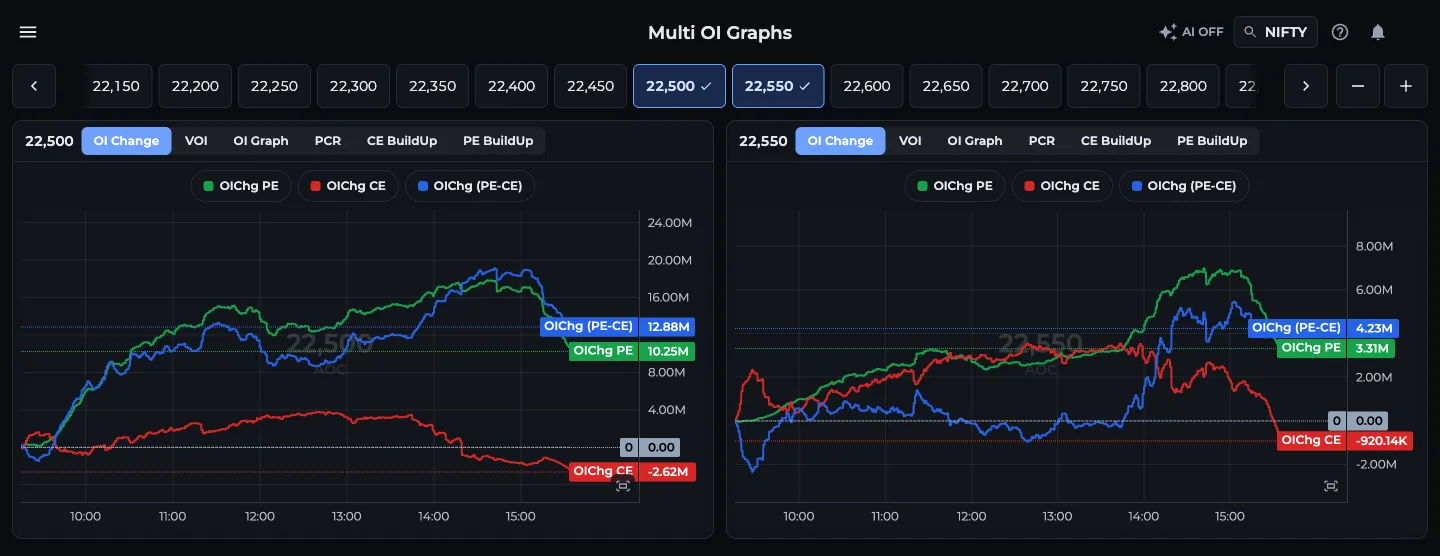
- OI Change: OIChg PE (green), OIChg CE (red) and OIChg (PE-CE) (blue) through the day, with a dashed zero line. This is the change in open interest since the previous close.
- VOI: volume divided by open interest for each side, VOI CE (red), VOI PE (green) and VOI (CE-PE) (blue). A high reading means a lot of trading compared to the positions that stay open, so the strike is busy with intraday churn.
- OI Graph: total open interest, OI PE, OI CE and OI (PE-CE), with a zero line.
- PCR: PCR OI (blue) is put OI divided by call OI for that one strike, and PCR OIChng (orange) is put OI change divided by call OI change. A dashed line marks 1. PCR OIChng reads 0 while either side's OI change is zero or negative.
- CE BuildUp and PE BuildUp: that side's OI change (orange, left axis) against its LTP (blue). Read them together to tell long buildup, short buildup, short covering and long unwinding apart, as explained in OI buildup.
How do I read the OI Change chart?
Say NIFTY trades at 24,480 and you have cards for 24,400, 24,500 and 24,600. On the 24,500 card, the green OIChg PE line climbs from 4 lakh at 10:00 to 22 lakh by 11:30, while the red OIChg CE line sits flat near 6 lakh. The blue (PE-CE) line rises well above zero.
That says put writers are building positions at 24,500 and nobody is fighting them on the call side. Traders read it as support forming at that strike. If by 14:00 the red line overtakes the green one and the blue line drops below zero, call writers have taken control of 24,500 and it starts acting like resistance.
Check the neighbours too. If 24,400 shows the same green climb, the support is broad. If only one strike shows it, treat it with less weight.
How do I read the CE BuildUp and PE BuildUp charts?
Take the 24,600 CE card on the CE BuildUp tab. The orange OI change line rises from 2 lakh to 15 lakh between 09:30 and 12:00 while the blue LTP line falls from 118 to 72. OI up with price down is short buildup: call writers are selling and winning.
If the orange line then turns down while LTP jumps, that is short covering, and it often comes with a sharp move up in the index. For the same idea across the whole chain rather than single strikes, see CE PE Buildup.
Which settings change these charts?
- Values in lots divides OI and OI change by the symbol's lot size, so a reading of 4,000 means 4,000 lots instead of units.
- Full numbers turns off compact formatting (lakh and crore or K and M, set under Compact number style).
- Under Multi OI, Remember last chart opens new cards on the tab you picked last. Turn it off and Default chart decides the starting tab. More in app settings.
Frequently asked questions
Is Multi OI Graphs free in AOC?
No. Multi OI Graphs needs a login and an active AOC plan (AOC Pro or higher). Free accounts are shown the plans screen when they open the page.
Can I see Multi OI Graphs for a past date?
No. The page always shows the latest trading day of the current expiry. To study a past session, use OI Graphs Replay for strike-wise bars or the Back Tester for the full option chain at any moment.
How many strikes can I compare at once?
You can add as many strikes as you like; each becomes its own chart card. The column buttons set how many cards sit in a row, up to six, depending on your screen width.
What is VOI in the Multi OI chart?
VOI is volume divided by open interest for that strike and side. A rising VOI means traders are turning over far more contracts than are being held, which usually points to heavy intraday activity at that strike rather than fresh positions being carried.
Last updated